Why Some Video Games Become Cultural Icons
Millions of video games have been released, but only a small number become something larger than games.
People who have never owned a Nintendo console recognize Mario. Pikachu appears on clothing, airplanes, birthday cakes, and store shelves around the world. Minecraft’s blocky visual style can be identified almost instantly. Grand Theft Auto became part of public debates about violence and entertainment. Fortnite dances escaped the screen and appeared in schools, sports celebrations, concerts, and social media.
These games reached a point where understanding them no longer required playing them.
That is what separates a successful video game from a cultural icon.
Sales obviously matter, but sales alone cannot explain it. Plenty of commercially successful games disappear from public conversation within a few years. Cultural icons survive because they become connected to memories, communities, technology, language, music, fashion, childhood, controversy, or a particular moment in history.
The games that achieve this status usually do several things at once: they arrive at the right time, create something people immediately recognize, give players experiences worth sharing, and remain culturally visible long enough to become part of life beyond the screen.
Cultural Impact Is Different From Commercial Success
A game can sell millions of copies without becoming culturally important.
Commercial success measures how many people purchased or played something. Cultural influence is harder to measure because it describes how deeply that thing enters the broader public imagination.
An iconic game produces references that survive outside its original context.
People recognize its characters. Its music is performed by orchestras. Its phrases become jokes. Children dress as its characters for Halloween. Its visual language appears in advertisements and internet memes.
Eventually, the game becomes familiar even to non-players.
That transition is rare.
It requires more than good gameplay.
Timing Can Matter as Much as Quality
Cultural icons often arrive at exactly the right technological or social moment.
Pong appeared when interactive electronic entertainment still felt futuristic. Super Mario Bros. arrived during a crucial period for home consoles. Pokémon emerged when portable gaming made trading creatures between friends possible.
World of Warcraft arrived as broadband internet was transforming online life. Wii Sports appeared when motion controls could introduce gaming to people intimidated by traditional controllers.
Pokémon Go arrived after smartphones, GPS, mobile internet, and cameras had become ordinary parts of everyday life.
Fortnite exploded during an era of livestreaming, social media, free-to-play games, and constant online connectivity.
In each case, the game was important partly because the world was ready for it.
A brilliant game released at the wrong moment can disappear.
A brilliant game arriving alongside a major technological or cultural shift can become the symbol of that shift.
The Most Iconic Games Are Easy to Recognize
Cultural icons usually have strong visual identities.
Mario’s red cap and mustache are instantly recognizable. Pac-Man can be represented by little more than a yellow circle with a missing wedge. Minecraft can be identified from a single blocky tree.
This simplicity matters.
A character or visual style that can be recognized in a fraction of a second travels easily beyond the game.
It works on T-shirts, toys, posters, memes, backpacks, advertisements, and costumes.
Complexity can make a game visually impressive, but cultural recognition often depends on something much simpler.
People need to recognize the idea immediately.
Great Characters Give Games a Face
Games are abstract products until audiences have something to attach themselves to.
Characters provide that connection.
Mario is not merely the protagonist of a platform game. He became the face of Nintendo and, for many people, the face of video games themselves.
Sonic represented Sega. Pikachu became the global symbol of Pokémon. Lara Croft became one of gaming’s earliest internationally recognizable human protagonists. Master Chief became inseparable from Xbox.
Characters allow franchises to move beyond gameplay.
A character can appear in films, television, toys, theme parks, advertisements, and merchandise without requiring the audience to understand the mechanics of the original game.
That gives cultural icons extraordinary reach.
Simple Ideas Travel Far
Many culturally dominant games can be explained surprisingly quickly.
Tetris asks you to arrange falling blocks.
Pokémon asks you to catch and train creatures.
Minecraft gives you blocks and lets you build.
The Sims lets you control everyday life.
Fortnite drops players into a shrinking battlefield until one person or team remains.
The actual games can contain enormous depth, but the central concept is understandable.
That matters because cultural ideas spread more easily when people can explain them to one another.
If someone needs twenty minutes to understand why a game is interesting, it has a harder path into mainstream culture.
The strongest concepts often fit into one sentence.
The Best Games Create Stories Players Tell Each Other
Traditional media gives audiences stories.
Games can create situations where players generate their own.
Ask someone about a favorite game and they may not describe the official storyline at all.
They might remember defeating a difficult boss with almost no health remaining. They might talk about a ridiculous multiplayer match with friends. They may remember getting lost in a Minecraft cave, catching a rare Pokémon, or surviving an impossible situation in an open-world game.
These moments become personal stories.
And personal stories spread.
Players tell friends, upload clips, create memes, post screenshots, and recreate moments online.
The game becomes a machine for generating conversation.
That is enormously valuable culturally because every player’s experience becomes another piece of unofficial marketing.
Multiplayer Turns Games Into Social Rituals
A single-player masterpiece can become iconic, but multiplayer games have an additional advantage.
They become places where people meet.
For generations of players, certain games are inseparable from friendship.
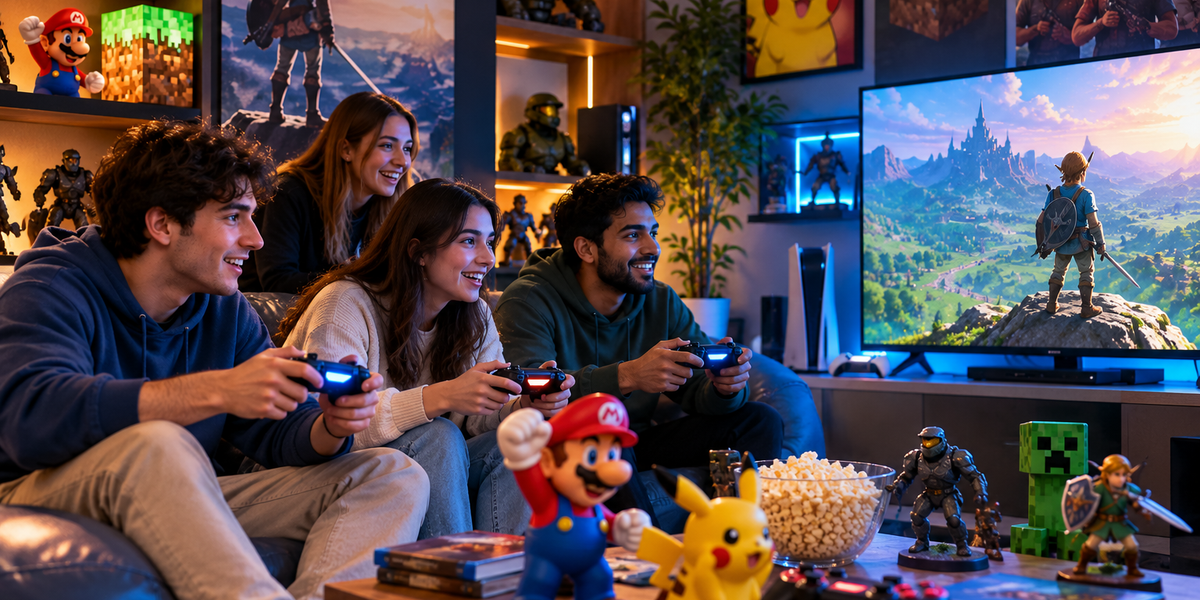
People remember sitting beside siblings playing Mario Kart, gathering around a television for GoldenEye, connecting consoles for Halo, joining guilds in World of Warcraft, building Minecraft servers, or talking with friends while playing Fortnite.
The game becomes attached to social memory.
Years later, players may barely remember who won.
They remember who was there.
That emotional connection can give games cultural staying power that technical achievements alone cannot create.
Childhood Is an Extremely Powerful Cultural Force
Games experienced during childhood often remain emotionally important for decades.
A child who first encountered Mario, Zelda, Sonic, or Pokémon in the 1990s may now be an adult with children of their own.
That creates generational transmission.
Parents introduce old games to their children. Companies release remakes and remasters. Characters return in films and merchandise.
What began as children’s entertainment becomes nostalgia, and nostalgia becomes a powerful commercial and cultural force.
This is one reason franchises can survive for decades.
Each new generation encounters the characters for the first time while older generations continue carrying emotional connections to them.
Music Can Escape the Game
Video game music once consisted of simple electronic sounds created under severe hardware limitations.
Yet many of those melodies became unforgettable.
The themes associated with Super Mario, The Legend of Zelda, Tetris, Pokémon, Final Fantasy, and other major franchises can trigger recognition within seconds.
Modern game music has become even more ambitious, involving orchestras, choirs, licensed songs, and sophisticated dynamic scores.
The most successful soundtracks develop lives beyond the games themselves.
They appear in concerts, videos, remixes, social media, sporting events, and fan performances.
Music is particularly powerful because it can trigger memories almost instantly.
A few notes can transport someone back twenty years.
Technological Breakthroughs Create Cultural Moments
Some games become iconic because they show audiences something they have never experienced before.
Super Mario 64 made free movement through a 3D world feel natural to a generation discovering three-dimensional console gaming.
Doom demonstrated the intensity of first-person action on PCs.
Grand Theft Auto III presented a city players could explore with unprecedented freedom.
World of Warcraft made a persistent online world feel socially enormous.
Minecraft demonstrated the creative potential of procedurally generated environments.
The breakthrough does not always remain impressive forever.
Technology moves quickly.
What matters is how it felt the first time.
People remember the moment the impossible suddenly became playable.
Sometimes a Game Defines an Entire Genre
Certain games become so influential that later games are described in relation to them.
Doom was so influential that first-person shooters were once commonly described as “Doom clones.”
Dark Souls helped establish the modern idea of the “Soulslike.”
Metroid and Castlevania became attached to the term “Metroidvania,” describing games built around exploration, interconnected environments, and abilities that unlock new paths.
Rogue inspired the language behind “roguelikes” and “roguelites.”
This is an extraordinary form of cultural influence.
The game’s name stops referring only to one product.
It becomes vocabulary for describing other games.
Accessibility Helps Games Reach Beyond Traditional Players
Some cultural phenomena happen because a game reaches people who do not normally identify as gamers.
Tetris is one of the clearest examples.
Its rules are understandable almost immediately, and it does not require knowledge of gaming conventions.
Wii Sports achieved something similar through physical movement.
Pokémon Go reached enormous numbers of smartphone users by connecting a familiar franchise with walking and real-world locations.
Mobile games expanded the audience even further.
When the barrier to entry becomes low enough, gaming can reach people who would never buy a traditional console.
Cultural reach grows when participation stops requiring membership in gaming culture.
Streaming Changed Which Games Become Famous
The rise of livestreaming and online video transformed the relationship between playing and watching games.
Some games are entertaining even when you are not the person holding the controller.
Competitive games create dramatic matches. Horror games generate entertaining reactions. Social games produce unpredictable conversations. Sandbox games give creators opportunities to invent challenges.
This creates a second audience.
Someone may know everything about a game despite barely playing it themselves.
Minecraft became deeply connected to online creators. Fortnite grew alongside livestreaming culture. Among Us experienced an enormous resurgence partly because watching groups deceive and accuse one another was entertaining.
A game can now become culturally dominant through spectators as well as players.
Memes Can Keep Games Alive
Modern cultural relevance is increasingly connected to remixing.
Players take characters, screenshots, animations, dialogue, glitches, and music and transform them into jokes.
Memes can introduce a game to people who have never played it.
Sometimes an obscure moment becomes more culturally recognizable than the game itself.
This kind of participation is difficult for companies to manufacture deliberately.
Marketing departments can encourage sharing, but genuine internet culture tends to emerge unpredictably.
When players begin using a game as raw material for their own humor and creativity, the game gains a cultural life beyond its developer’s control.
Controversy Can Make Games More Famous
Not every cultural icon becomes famous purely through admiration.
Grand Theft Auto became part of repeated debates about violence, crime, and mature content.
Mortal Kombat’s graphic violence contributed to political discussions about video game ratings.
Other games have generated controversies involving addiction, monetization, representation, online behavior, or the effects of gaming on children.
Controversy can expose games to enormous audiences that would otherwise never hear about them.
Parents, politicians, journalists, and television commentators begin discussing a product originally intended for players.
Sometimes attempts to condemn a game unintentionally make it more culturally visible.
Scarcity Once Helped Create Shared Experiences
Before digital distribution and enormous online libraries, players often had access to fewer games.
That created stronger shared reference points.
If many children owned the same console and only a handful of major games were released during a particular season, a large portion of the audience might play the same titles.
Everyone knew Mario.
Everyone knew Pokémon.
Everyone knew the latest major console release.
Modern players have access to an overwhelming amount of entertainment.
That is wonderful for variety but makes universal cultural moments harder to create.
Today’s iconic games often need enormous online communities to overcome this fragmentation.
Franchises Stay Relevant by Reinventing Themselves
Longevity requires more than releasing the same game repeatedly.
Mario has appeared in traditional platformers, racing games, sports titles, role-playing games, party games, and countless other formats.
Pokémon expanded into television, cards, films, mobile games, toys, and competitive play.
Successful franchises preserve enough familiar elements to remain recognizable while changing enough to attract new audiences.
This balance is difficult.
Change too little and the franchise becomes stale.
Change too much and it can lose what people loved about it.
Cultural icons survive by evolving without becoming unrecognizable.
Merchandise Makes Digital Characters Physical
Games exist primarily on screens, but cultural icons escape into the physical world.
Children sleep beside plush Pokémon. Mario appears on lunch boxes. Minecraft covers backpacks and bedroom decorations. Gaming characters become collectible figures, clothing, toys, and costumes.
Merchandise does more than generate revenue.
It increases cultural visibility.
A child can recognize Pikachu before ever playing Pokémon because the character appears everywhere.
At that point, the franchise no longer depends entirely on the original medium.
The game has become a brand, character universe, and cultural symbol.
Movies and Television Expand the Audience Again
For decades, adaptations of video games had an unfortunate reputation.
Many were poorly received because filmmakers struggled to translate interactive experiences into linear stories.
That has changed considerably as gaming has become more culturally powerful and entertainment companies have invested more seriously in adaptations.
Successful films and television series can introduce gaming characters and worlds to millions of people who may never play the original titles.
This creates a feedback loop.
Games generate adaptations. Adaptations create new fans. Those fans discover the games. The franchise becomes increasingly independent of any single product.
At that stage, it begins functioning more like a broad entertainment property than simply a video game series.
Iconic Games Usually Have Something Imitators Cannot Copy
When a game becomes successful, competitors naturally study it.
Mechanics can be copied. Business models can be copied. Visual trends can be imitated.
But cultural meaning is much harder to reproduce.
Another game can contain monster collecting without becoming Pokémon.
Another platformer can feature an expressive mascot without becoming Mario.
Another building game can use blocks without recreating Minecraft’s cultural position.
The original often owns the association in people’s minds.
Being first is not always necessary, but becoming the definitive version of an idea can create an enormous advantage.
Communities Keep Games Relevant
A game’s official development may eventually stop, but communities can extend its life dramatically.
Players create mods, tournaments, fan art, speedruns, guides, videos, challenges, and unofficial content.
They discover hidden mechanics years later.
They preserve old servers and develop emulators. They introduce games to younger players.
In some cases, the community becomes almost as important as the original developer in maintaining the game’s cultural presence.
This is especially powerful because community activity feels participatory.
People are not simply consuming a franchise.
They are helping maintain it.
Nostalgia Eventually Becomes a Business
Once a game survives long enough, nostalgia becomes commercially valuable.
Old consoles are recreated in miniature. Classic games receive remasters. Soundtracks are released on vinyl. Retro merchandise appears in stores.
Companies know that adults will pay to reconnect with experiences from childhood.
But nostalgia can also introduce old games to entirely new audiences.
A parent buys a classic collection because they remember playing it twenty-five years ago. Their child plays it for the first time.
The cultural cycle begins again.
This is how entertainment that once seemed tied to one technological generation can survive several.
Not Every Great Game Becomes an Icon
Some extraordinary games never achieve mainstream recognition.
They may belong to niche genres, appear on unpopular hardware, receive weak marketing, or arrive at the wrong time.
Cultural importance is not a perfect measurement of artistic quality.
It contains an element of luck.
The right game needs to reach the right audience under the right conditions.
Sometimes an excellent game becomes famous years after release. Sometimes a mediocre game becomes culturally significant because it happens to capture a particular moment.
History does not always reward the “best” work.
It often remembers the work that became connected to something larger.
Cultural Icons Become Part of People’s Identities
Eventually, certain games become more than entertainment people enjoy.
They become part of how people describe themselves.
Someone is a Zelda fan. A Pokémon fan. A Minecraft player. A member of a particular World of Warcraft guild. A lifelong PlayStation or Nintendo player.
People wear clothing associated with these games, decorate rooms with their characters, travel to conventions, collect merchandise, and form friendships around shared interests.
The game becomes connected to identity and community.
That is much harder to replace than simple entertainment.
A person can finish a game.
It is harder to “finish” a culture.
The Biggest Games Become Memories of an Era
Ask people about the games they loved growing up and the answers often contain more than information about games.
They remember the television they played on.
They remember sitting beside a sibling.
They remember trading Pokémon at school, playing Halo at a friend’s house, staying up too late in World of Warcraft, building Minecraft worlds after class, or meeting friends online in Fortnite.
The technology becomes attached to a period of life.
That is the final ingredient that companies cannot manufacture directly.
They can create characters, spend millions on advertising, build sophisticated technology, and design excellent games.
But they cannot order an audience to form memories.
That happens naturally when the right game becomes part of enough people’s lives at the right moment.
And once that happens, the game stops belonging only to the company that created it.
It belongs to a generation.
That is how a video game becomes a cultural icon.