The Real Story of How Games Get Made
A finished video game can make its creation look almost inevitable. The world has a visual identity, the characters belong there, the controls feel deliberate, the music arrives at the right moments, and every menu appears to have been designed as part of one coherent plan.
Development rarely feels that organized from the inside.
Games usually begin as incomplete ideas. Features are invented and removed. Characters change. Levels are rebuilt. Technology fails. Deadlines move. Entire systems that took months to create can disappear because they simply are not fun. Developers may spend years working on details players will pass in seconds, while a seemingly tiny last-minute problem can threaten the entire release.
Making a game is not simply programming with some artwork added afterward. It is the coordination of design, engineering, art, animation, writing, audio, production, testing, business decisions, and thousands of compromises.
The real story of how games get made is much less tidy than the finished product suggests.
Every Game Starts With an Idea, but Ideas Are Cheap
Almost everyone who plays games has had a game idea.
Maybe it is an enormous fantasy world where every character remembers your decisions. Perhaps it is a survival game set on another planet or a simple puzzle game built around one clever mechanic.
Coming up with the idea is usually the easy part.
The difficult question is whether that idea can actually become a functioning game.
Developers need to determine what the player does from moment to moment, why those actions are enjoyable, what technology is required, how much content needs to be created, how many people are necessary, and whether the project can realistically be completed with the available time and money.
A great concept can still be impossible to build at the intended scale.
Game development therefore begins with imagination but quickly becomes an exercise in constraints.
The First Version Usually Looks Terrible
Before developers build beautiful environments and detailed characters, they often create prototypes.
A prototype exists to answer questions.
Is the movement enjoyable? Does the combat system work? Is the central puzzle mechanic interesting? Can the technology support the idea?
These early versions can look extremely rough.
Characters may be represented by simple shapes. Environments can consist of gray boxes. Animations might be missing entirely. Sound effects may be temporary.
That is intentional.
There is little reason to spend months creating beautiful artwork for a mechanic that might be abandoned next week.
The prototype is not trying to impress players.
It is trying to prove that there is a game worth making.
Developers Search for the “Core Loop”
One of the most important concepts in game design is the core gameplay loop.
This is the sequence of actions players repeatedly perform.
In a racing game, the loop might involve racing, earning rewards, improving vehicles, and entering harder races.
In a survival game, it might involve exploring, gathering resources, crafting equipment, building shelter, and exploring farther.
In a role-playing game, players may fight enemies, gain experience, improve their character, acquire better equipment, and face stronger challenges.
If the core loop is not satisfying, adding more content rarely solves the problem.
A hundred hours of boring gameplay is still boring.
Developers therefore spend significant time trying to make the fundamental interactions enjoyable before expanding them into a full game.
Pre-Production Turns the Idea Into a Plan
Once a concept shows enough promise, development can move into pre-production.
This is where the team begins answering larger questions.
What is the game’s visual style? How large will the world be? What platforms will it support? What engine will it use? How many characters, levels, enemies, and missions are required? Will there be multiplayer? How long should the game take to complete?
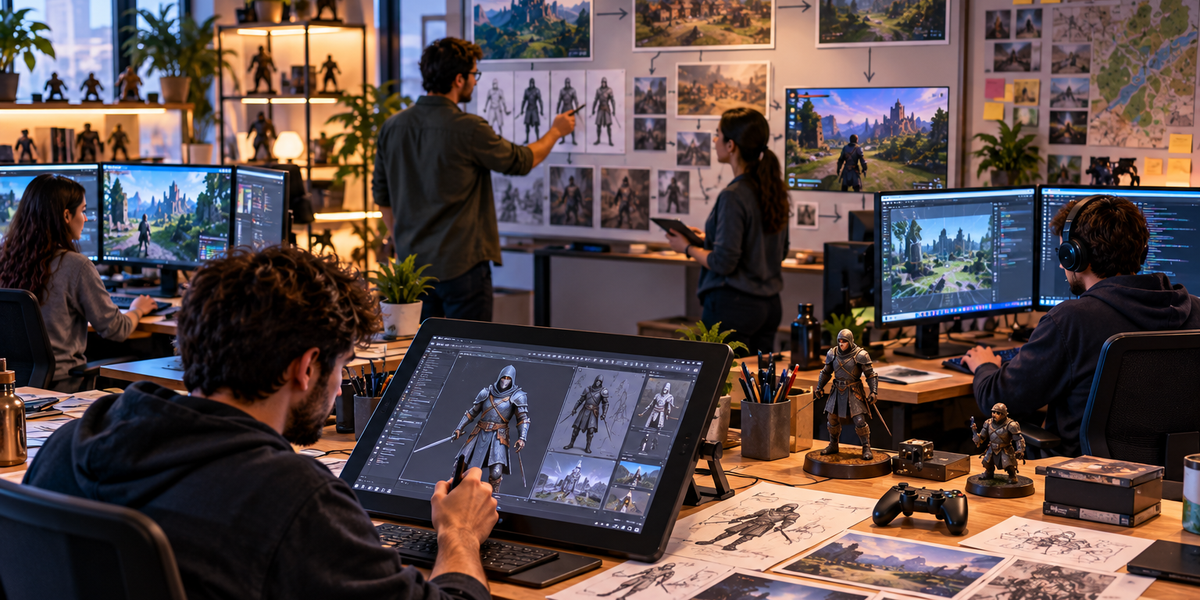
Writers may develop the story and characters. Artists create concept art. Designers build early levels. Engineers investigate technical requirements.
Producers begin estimating schedules and staffing.
The goal is to transform an exciting idea into something that can actually be built.
This is also where teams should begin confronting uncomfortable realities.
If the plan requires twice the available budget, something needs to change.
The Game Engine Provides the Foundation
Most modern games are built using a game engine.
The engine provides fundamental systems that developers would otherwise need to create from scratch.
It can handle rendering graphics, processing physics, managing animation, playing audio, loading levels, receiving controller input, and performing many other technical tasks.
Some studios use widely available commercial engines. Others maintain proprietary technology developed specifically for their games.
Choosing an engine can shape the entire project.
An engine excellent for a small 2D game may not be appropriate for an enormous photorealistic open world. Technology designed around single-player experiences may require major changes to support large-scale multiplayer.
The engine is not the game itself.
It is closer to the workshop in which the game is constructed.
Designers Decide What the Player Actually Does
Game designers create and refine the rules and systems that define the experience.
They determine how quickly a character moves, how combat works, how much damage weapons cause, how resources are distributed, how abilities interact, and what happens when players succeed or fail.
Level designers focus on the spaces where those systems operate.
They decide where paths lead, where enemies appear, how challenges escalate, where players are likely to look, and how environments guide movement without always making that guidance obvious.
These decisions can appear simple when they work.
A perfectly positioned doorway may naturally pull the player’s attention toward the next objective.
The player never notices the design.
That is often the point.
Programmers Make the Systems Work
Game programmers turn designs into functioning software.
Different engineers may specialize in different areas.
Gameplay programmers build mechanics. Graphics engineers work on rendering technology. AI programmers create systems controlling non-player characters. Network engineers handle online communication. Tools programmers create software that helps other developers build the game.
Large games can contain millions of lines of code.
Every system also interacts with others.
Changing character movement might affect animation. Changing physics can break level design. Updating networking code might influence combat timing.
Programming a game is therefore not simply about making individual features work.
Those features must work together.
Artists Build the World
Concept artists help establish what the game should look like before production teams build final assets.
Once the visual direction is established, specialized artists begin creating the world.
Character artists create people and creatures. Environment artists build buildings, landscapes, furniture, vegetation, and countless other objects. Texture artists create surface details. Lighting artists determine how environments are illuminated.
Technical artists work between the artistic and engineering sides of development, helping ensure that ambitious visuals actually run efficiently.
A single room in a modern game may contain dozens or hundreds of individually created assets.
Players might spend thirty seconds walking through it.
Someone may have spent weeks building it.
Animation Makes Digital Characters Feel Alive
A character model standing motionless is essentially a digital sculpture.
Animation turns it into something that appears alive.
Characters need to walk, run, jump, fight, react, speak, climb, fall, and interact with objects.
Some animations are created manually. Others use motion capture, where performers’ movements are recorded and transferred into digital characters.
Even motion capture requires substantial cleanup and adjustment.
Games also need systems capable of blending animations together.
A character might need to transition smoothly from running to jumping while turning and holding a weapon.
The player expects that movement to look natural even though several animation systems may be working simultaneously.
Writers Do More Than Create the Main Story
Writing a game can be considerably more complicated than writing a linear film.
A movie generally unfolds in a predetermined order.
Games may allow players to explore, ignore objectives, choose dialogue options, complete missions in different sequences, or make decisions that change later events.
Writers therefore need to account for multiple possibilities.
They may create main story scenes, optional conversations, environmental text, item descriptions, tutorials, mission dialogue, background characters, and countless small interactions.
Large role-playing games can contain enormous amounts of written and recorded dialogue.
And because games change during development, writers often rewrite material when missions, characters, or entire systems are redesigned.
Audio Is Built Layer by Layer
Games contain far more sound than most players consciously notice.
Footsteps change depending on the surface. Weapons produce different sounds depending on distance and environment. Weather creates background ambience. Buildings may have subtle room tones.
Sound designers create and organize these elements.
Composers write music that may need to react dynamically to gameplay.
A calm exploration track can transition into combat music when enemies appear and return smoothly when danger ends.
Voice actors record dialogue, sometimes across thousands of lines.
Audio is particularly powerful because players often notice when it is wrong without understanding why.
A visually impressive game with weak sound can feel strangely lifeless.
The “Vertical Slice” Shows What the Final Game Could Be
During development, teams sometimes create what is called a vertical slice.
This is a relatively small section of the game developed to something approaching final quality.
It might contain polished graphics, representative gameplay, finished audio, and other major systems.
The purpose is not necessarily to create a portion that will immediately ship.
The vertical slice demonstrates what the finished game is supposed to become.
It can help the development team establish production standards and identify technical problems.
It can also be shown to publishers, executives, or investors to demonstrate that the project is viable.
The difficult part comes afterward.
Creating ten polished minutes is one challenge.
Creating thirty polished hours is another.
Production Is Where Everything Gets Huge
Once the fundamental design and technology are established, full production begins.
This is when content creation expands dramatically.
Artists build environments. Designers construct levels and missions. Programmers implement systems. Writers produce dialogue. Animators create thousands of movements.
Large teams may work on different sections simultaneously.
One group might build a city while another creates combat encounters and another develops cinematic sequences.
External studios can contribute additional artwork, animation, testing, or development.
The number of moving pieces becomes enormous.
Production is where ambitious plans meet the reality of schedules.
Features Get Cut Constantly
Players sometimes discover unused files or hear developers discuss features that never appeared in the final game.
This is normal.
Games change throughout development.
A mechanic that sounded excellent in a design document may not be enjoyable in practice. A planned area may require too much work. A character may no longer fit the story.
Sometimes a feature works perfectly but still gets removed because the team does not have enough time to polish everything else.
Cutting content can feel painful because people may have spent months creating it.
But finishing a game requires deciding what not to make.
A smaller polished game is usually better than a huge unfinished one.
“Fun” Is Surprisingly Difficult to Measure
One of the strangest problems in game development is that nobody can reliably calculate fun in advance.
A design can look brilliant on paper and feel terrible when played.
Another idea that sounds ridiculous can become the best part of the game.
This is why iteration is so important.
Developers build something, play it, observe what happens, make changes, and test again.
A character may move slightly faster. An enemy might attack less frequently. A weapon’s sound can change. A level can be shortened.
Individually, these changes may appear insignificant.
Together, thousands of small adjustments determine how the game feels.
Playtesting Reveals What Developers Cannot See
After working on a game for years, developers know too much about it.
They know where to go, what every button does, how every puzzle works, and what every symbol means.
New players do not.
Playtesting allows developers to observe people encountering the game without that knowledge.
Perhaps players repeatedly miss an important doorway. Maybe they misunderstand a tutorial. A boss that developers consider easy might defeat new players repeatedly.
The important part of playtesting is often watching rather than explaining.
If every tester gets lost in the same corridor, the problem may not be the players.
The corridor probably needs to change.
Quality Assurance Is Much More Than “Playing Games All Day”
Game testing sounds like a dream job until you understand what professional quality assurance actually involves.
QA testers deliberately try to break the game.
They repeat actions, explore unusual combinations, test different hardware, reproduce crashes, document problems, and verify whether fixes actually work.
Imagine testing the same mission dozens of times because a character occasionally disappears during one specific animation.
That is very different from casually playing for entertainment.
Testers need to describe bugs precisely enough that developers can reproduce them.
“The game broke” is not useful.
A valuable report explains what happened, what should have happened, what steps caused the problem, and how consistently it can be reproduced.
Bugs Can Come From Unexpected Places
Games contain enormous networks of interacting systems.
Fixing one problem can accidentally create another.
Suppose developers change the physics controlling doors.
That might fix one animation but unexpectedly prevent an enemy from moving through certain entrances.
A lighting update could hurt performance in one level. A networking fix could introduce problems elsewhere.
This is why software testing continues throughout development.
As the game becomes larger, the number of possible interactions becomes difficult to comprehend.
Players will inevitably do things developers never predicted.
Optimization Happens Throughout Development
A game can technically work and still perform badly.
Perhaps the frame rate drops whenever too many enemies appear. Maybe a city requires too much memory. Loading takes too long.
Optimization involves making the game use hardware resources more efficiently.
Artists may simplify distant objects. Engineers improve code. Designers reduce expensive effects. Memory usage is reorganized.
Developers constantly balance visual quality, simulation complexity, resolution, and frame rate.
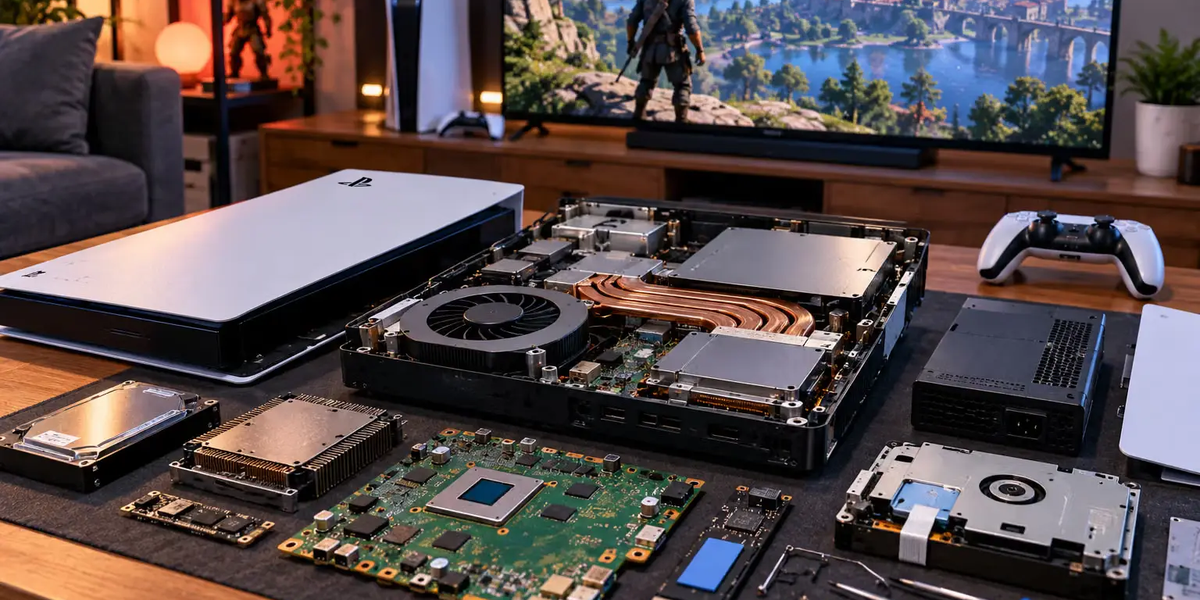
Optimization is especially important on consoles because the hardware configuration is fixed.
There is no option to tell the player to buy a better graphics card.
The game has to work on the machine it was designed for.
Multiplayer Makes Everything Harder
A single-player game only needs to maintain one player’s version of events.
Online multiplayer needs multiple machines to agree about what is happening despite network delays.
If one player fires at another, the game needs to determine where both players were, whether the shot connected, and how that information should be synchronized.
Connections fail. Players disconnect. Servers experience heavy demand. Network latency varies dramatically.
Developers also need matchmaking, accounts, security, moderation, and infrastructure capable of supporting potentially enormous numbers of players.
Adding multiplayer is not simply adding a button to the menu.
It can fundamentally change the engineering requirements of the entire project.
The Business Side Shapes the Game Too
Games are creative works, but they are also products.
Someone has to pay for development.
Publishers and investors therefore care about budgets, release schedules, sales expectations, competition, and potential audiences.
These pressures can influence creative decisions.
A publisher might want the game released before a particular holiday. A feature may be added because market research suggests players expect it. A project can be expanded after early enthusiasm or reduced when costs become too high.
Independent developers face business pressures too.
They may have more creative control, but they still need enough money to finish development and continue paying themselves.
Creative ambition always exists alongside economic reality.
Delays Are Sometimes the Least Bad Option
When a game is not ready, developers face an unpleasant choice.
They can delay it, reduce its scope, or release it with known problems.
None of those options is ideal.
Delays cost money and can disrupt marketing plans. Cutting features can disappoint players. Releasing an unfinished game can damage the studio’s reputation.
Publicly announced release dates therefore create enormous pressure.
Players often become frustrated when games are delayed, but the alternative can be worse.
Software development is difficult to predict because some problems cannot be understood until the systems are actually built.
Crunch Is One of the Industry’s Most Controversial Problems
As deadlines approach, some studios enter periods of intense overtime commonly called crunch.
Developers may work long days, nights, or weekends trying to finish the game.
Crunch can emerge from unrealistic schedules, changing requirements, technical problems, poor management, or the sheer difficulty of predicting creative work.
Historically, parts of the games industry treated extreme overtime almost as a badge of commitment.
That attitude has faced increasing criticism.
Sustained overwork can damage people’s health, relationships, morale, and ultimately the quality of the work itself.
The fact that players desperately want a game does not make the people creating it unlimited resources.
Eventually the Game Reaches “Content Complete”
At some stage, developers need to stop adding major things.
The game may reach a state where the intended levels, systems, story, characters, and other major content are present.
That does not mean it is ready.
Now the focus increasingly shifts toward fixing bugs, improving performance, balancing systems, polishing presentation, and preparing the game for release.
This period can be intense because thousands of small issues become visible.
A nearly finished game can sometimes feel more frustrating than an early prototype because expectations are now much higher.
The final 10 percent can consume a disproportionate amount of effort.
Console Games Need Certification
Releasing a game on a console requires more than simply uploading the finished files.
Platform holders maintain technical and policy requirements that games must satisfy.
Developers need to ensure that controllers behave correctly, system notifications work, account features function, error messages are handled properly, and the software interacts correctly with the console environment.
A game that fails certification may need fixes before it can be released.
This process helps maintain consistency across the platform.
It also adds another deadline and another set of requirements to an already complicated production schedule.
The “Gold” Version Is Not Really the End Anymore
Historically, a game “going gold” meant the final version had been approved for manufacturing physical copies.
The phrase still exists, but modern development rarely ends there.
Developers often continue fixing bugs while physical discs are being produced or digital stores prepare for launch.
Those fixes may become a day-one patch.
This is why installing a newly purchased game can immediately trigger a large download.
The version placed on the disc may have been finalized weeks earlier, while development continued.
Modern internet-connected consoles have made games much easier to update.
That flexibility is useful, but it has also changed expectations around what “finished” means.
Launch Day Is Both an Ending and a Beginning
After years of work, the game finally becomes available to the public.
Then millions of players immediately begin doing things the developers never expected.
Servers can become overloaded. Previously undiscovered bugs appear. Players discover balancing problems. Some finish content much faster than anticipated.
Developers monitor crash reports, social media, reviews, telemetry, and support requests.
Urgent patches may be prepared.
For online games, launch can feel less like finishing development and more like beginning a new phase.
The game has left the controlled environment of the studio and entered the chaos of the real world.
Modern Games Can Be Developed for Years After Release
The old model of game development was relatively simple: make the game, release it, move on.
That model still exists, but many games now continue evolving after launch.
Developers release expansions, new characters, maps, seasons, balance updates, cosmetic items, story chapters, and technical improvements.
Some games remain active for a decade or longer.
This changes development fundamentally.
Teams need long-term roadmaps, server infrastructure, community management, and systems capable of supporting content that did not exist when the original game launched.
The release date is no longer necessarily the end of development.
It can be the beginning of the game’s public life.
Sometimes Games Get Cancelled
Not every game reaches players.
Studios cancel projects for countless reasons.
The game may not be fun. Technology may fail. Development may become too expensive. The market may change. A publisher may alter its strategy.
Sometimes hundreds of people have already spent years working on a project when it is cancelled.
To the public, the game may never have existed.
To the developers, it represented years of their professional lives.
Cancelled games are a largely invisible part of the industry, but they reveal something important: game development is never guaranteed to produce a finished product.
The Credits Reveal How Complicated Games Have Become
The next time you finish a major game, watch the credits.
They can continue for an astonishing amount of time.
Programmers, artists, designers, writers, producers, actors, composers, sound engineers, QA testers, localization teams, marketing departments, legal teams, external studios, technology providers, and countless others may have contributed.
Even relatively small games often require expertise across many disciplines.
The player experiences one unified world.
Behind that world is a network of people solving thousands of completely different problems.
Games Are Built Through Compromise
Perhaps the biggest misconception about game development is that developers simply imagine the perfect version of a game and then build it.
The real process is much messier.
The original idea meets the available technology. The technology meets the budget. The budget meets the schedule. The schedule meets unexpected problems.
Something has to change.
Developers constantly choose between features, performance, visual quality, complexity, time, and cost.
The final game is not necessarily everything the team dreamed about at the beginning.
It is the version they managed to make work.
The Finished Game Hides the Work That Created It
When development succeeds, all of this complexity disappears.
The player presses Start.
A character moves naturally. The music begins. Enemies behave correctly. The world loads as you approach it. The controller responds immediately. Dialogue triggers at the right moment. Thousands of systems cooperate without drawing attention to themselves.
You do not see the prototype where the character was a gray cube. You do not see the level that was rebuilt six times, the animation that broke every door, the bug that kept programmers awake before launch, or the feature that twenty people worked on before it was removed.
You see the finished game.
That illusion of effortlessness may be one of game development’s greatest achievements.
A game is built from code, artwork, mathematics, sound, writing, technology, money, and thousands upon thousands of decisions. Somehow, all of those separate pieces eventually become one experience.
And if everyone has done their job well, the player never thinks about any of them.
They simply pick up the controller and play.