The Gadgets Worth Buying (And the Ones That Are a Waste)
Technology companies are exceptionally good at convincing us that one more gadget will make life easier. There is always a smarter watch, smaller charger, more advanced kitchen appliance, AI-powered accessory, or connected device promising to save time and solve a problem you did not realize you had.
Some gadgets genuinely earn their place in your life. They solve an annoying problem repeatedly, replace several other products, save meaningful time, or make something you already do significantly easier. Others are exciting for approximately three days before ending up in a drawer beside old cables, abandoned fitness trackers, and mysterious adapters nobody remembers buying.
The difference rarely comes down to how technologically impressive a product is. The gadgets worth buying are usually the ones that disappear into your routine. You stop thinking about them because they simply work. The gadgets that are a waste tend to demand more attention than the problem they were supposed to solve.
So before buying another piece of technology, it is worth asking a simple question: will this actually improve something I regularly do?
Worth It: A Good Portable Power Bank
Few gadgets solve such an obvious problem as reliably as a portable power bank. Phones have become our cameras, maps, boarding passes, wallets, translators, entertainment systems, and primary communication devices, which means a dead battery can create considerably more trouble than it once did.
A good power bank is particularly useful when traveling, attending events, hiking, commuting, or spending long periods away from an outlet. Modern models can provide enough power to recharge a smartphone several times, and more capable USB-C versions can charge tablets and even some laptops.
The key is buying the right capacity rather than the largest possible battery. Massive power banks are heavy enough that many people stop carrying them, defeating the purpose. A smaller model that actually lives in your bag is often more useful than a giant battery sitting at home.
This is a gadget worth buying because you may barely notice it most days, but when you need it, you really need it.
Usually a Waste: Ultra-Cheap Power Banks
A power bank is useful. A suspiciously cheap power bank from an unknown manufacturer is a different proposition.
Batteries store significant amounts of energy, and their charging electronics need to manage voltage, current, heat, and safety correctly. Saving a small amount of money on poorly made battery products is rarely worth the tradeoff.
Very cheap models may also exaggerate their advertised capacity. A battery claiming an enormous capacity in an impossibly small body should immediately raise questions.
For power-related accessories, reliability matters more than having the lowest possible price. The same principle applies to chargers and cables. These products interact directly with expensive electronics and electrical power, so this is not the category where bargain hunting makes the most sense.
Worth It: A High-Quality Multi-Port USB-C Charger
The transition toward USB-C has made one of the least exciting gadgets surprisingly valuable: a good charger.
Instead of carrying separate power adapters for a phone, tablet, laptop, headphones, and other devices, one sufficiently powerful multi-port charger can often handle several of them.
Modern chargers using technologies such as gallium nitride, commonly called GaN, can deliver substantial power from relatively compact designs. That makes them especially convenient for travel.
The benefit is not flashy. You simply carry fewer chargers, occupy fewer wall outlets, and spend less time figuring out which adapter belongs to which device.
Those small conveniences add up because charging is something most people do every day.
Usually a Waste: A Separate Charger for Every Device
Many people accumulate chargers without ever reconsidering whether they still need them.
One adapter came with an old phone. Another belongs to a tablet. There is a laptop charger, a travel charger, a charger beside the bed, and three mysterious adapters in a drawer.
If your devices support compatible USB-C charging standards, much of that clutter can often be consolidated.
There are exceptions, particularly for devices requiring proprietary charging systems or unusually high power. But for an increasingly large number of everyday electronics, maintaining a collection of nearly identical chargers creates more clutter than value.
The better purchase is usually one or two reliable, appropriately powerful chargers that can handle several devices.
Worth It: Noise-Canceling Headphones
Active noise-canceling headphones are one of those technologies that can sound unnecessary until you use a good pair in the right environment.
They are especially valuable on airplanes, trains, public transportation, shared offices, and other places with constant background noise.
Noise cancellation works particularly well against steady low-frequency sounds such as aircraft engines and ventilation systems. Instead of increasing music volume to overpower the environment, you can listen more comfortably.
For frequent travelers or people who regularly work in noisy spaces, this can significantly improve concentration and comfort.
They are not essential for everyone. If you primarily listen to music at home in a quiet room, expensive noise cancellation may provide little additional value. But for the right person, it is one of the rare premium features that can genuinely change the experience.
Usually a Waste: Extremely Cheap Wireless Earbuds
Wireless earbuds have become inexpensive enough that hundreds of models now compete at the bottom of the market.
Some budget options are perfectly good, but there is a point where low prices usually mean compromises in battery quality, microphone performance, connection reliability, durability, controls, or sound.
The biggest frustration is often not mediocre audio. It is inconsistency. One earbud stops connecting, the case fails to charge properly, microphones make calls difficult, or the battery deteriorates quickly.
A slightly more expensive pair that works reliably for several years can be cheaper in practice than repeatedly replacing disposable alternatives.
Technology that you use every day should reduce friction, not create new forms of it.
Worth It: A Good External SSD
Cloud storage is convenient, but a portable solid-state drive remains incredibly useful.
External SSDs can transfer large amounts of data quickly while being small enough to carry in a pocket or laptop bag. They are useful for backups, photographs, video projects, work files, travel, and moving information between computers.
Unlike traditional portable hard drives, SSDs contain no spinning platters or moving read/write heads, making them better suited to being carried around.
They should not be your only backup, particularly for irreplaceable files, but they are an excellent component of a broader backup strategy.
For people who create large files or work across multiple devices, a portable SSD often becomes one of those purchases that gets used far more frequently than expected.
Usually a Waste: Tiny USB Drives Bought Only Because They Are Cheap
USB flash drives still have legitimate uses, particularly for transferring small files or creating bootable installation media.
The problem is buying piles of cheap drives simply because they are inexpensive.
Low-cost flash drives can have painfully slow write speeds, questionable durability, and capacities that become inconvenient surprisingly quickly. Some fraudulent products even report storage capacities they do not actually possess.
If you regularly move substantial amounts of data, a reliable external SSD is usually a better long-term purchase.
The humble USB drive still has a place. It just no longer needs to occupy half a drawer.
Worth It: A Smartwatch, but Only for the Right Person
Smartwatches are an interesting category because they can be either extremely useful or almost completely unnecessary depending on the person wearing them.
If you exercise regularly, track workouts, use navigation while walking, rely on timers, want quick access to notifications, or appreciate having certain phone functions available without taking out your phone, a smartwatch can become genuinely useful.
It can also reduce phone checking. Instead of pulling out your phone every time it vibrates and potentially becoming distracted by several other apps, you can glance at your wrist and decide whether the notification matters.
However, a smartwatch only provides value if you actually use those capabilities.
Buying one because it seems like the natural accessory to a smartphone often results in an expensive notification screen that needs charging every few days.
Usually a Waste: A Smartwatch Upgrade Every Year
Even people who love smartwatches rarely need the newest model every year.
Annual updates often bring incremental improvements rather than transformative changes. A slightly brighter screen, somewhat faster processor, new sensor, or modest battery improvement may be nice without meaningfully changing daily use.
This applies to many mature technology categories.
When products improve rapidly, frequent upgrades can make sense. Once a category matures, the difference between consecutive generations becomes much smaller.
The smartest upgrade cycle is therefore based on what your current device can no longer do rather than what the latest advertisement says the new device can do.
Worth It: A Robot Vacuum for the Right Home
Robot vacuums are another gadget that can sound frivolous until they become part of a routine.
Their greatest advantage is not that they clean better than a powerful traditional vacuum. Usually they do not.
Their advantage is frequency.
A robot that automatically cleans the floor several times a week can prevent dust, crumbs, pet hair, and everyday debris from accumulating. You may still need to perform deeper cleaning occasionally, but the baseline cleanliness of the home can improve significantly.
They work particularly well in homes with relatively open floors and limited clutter.
In a house filled with stairs, loose cables, toys, unusual floor transitions, and obstacles, the robot may require so much preparation and rescue that much of the convenience disappears.
Usually a Waste: Smart Versions of Things That Do Not Need to Be Smart
Not every household object becomes better when connected to Wi-Fi.
Smart appliances can be useful when connectivity solves a real problem. A thermostat that adjusts heating efficiently or a security camera that sends meaningful alerts can provide obvious benefits.
But many connected products exist primarily because manufacturers discovered that they could add an app.
A device that previously required pressing one button may now require opening an app, waiting for it to connect, signing into an account, installing firmware updates, and hoping the manufacturer’s servers still exist five years from now.
If adding internet connectivity makes a simple task more complicated, the product has probably moved in the wrong direction.
Worth It: Smart Plugs
Smart plugs are an example of simple smart-home technology that can genuinely be useful.
They allow ordinary electrical devices to be switched on and off remotely or according to schedules. Lamps, fans, holiday lights, and certain appliances can become automated without replacing the devices themselves.
The advantage is flexibility. Instead of buying an expensive “smart” version of every lamp, you can add basic automation to something you already own.
Smart plugs are inexpensive enough that they do not need to transform your life to justify themselves.
They simply need to remove one small recurring inconvenience.
That is often the sign of a good gadget.
Usually a Waste: Smart Appliances With Features You Will Never Use
A refrigerator with an enormous touchscreen may look futuristic in a showroom, but it is worth asking whether the screen actually improves refrigeration.
Technology added to long-lived household appliances creates an unusual problem. A refrigerator might remain useful for fifteen years, while the software platform running its smart features could feel outdated much sooner.
Apps can lose support. Online services can shut down. Touchscreens can age. Manufacturers can stop releasing updates.
There is nothing inherently wrong with smart appliances, but the connected features should provide enough practical value to justify adding another potential point of failure.
A good refrigerator needs to remain a good refrigerator even after its software stops feeling modern.
Worth It: An E-Reader for People Who Read Regularly
For regular readers, an e-reader is one of the few single-purpose gadgets that still makes enormous sense.
E-ink displays are designed to resemble printed pages and can be comfortable to read for long periods. Battery life can last far longer than that of tablets, and a small device can store an entire library.
E-readers are also deliberately less capable than tablets, which can be an advantage. There are fewer notifications, videos, social media feeds, and other distractions competing for attention.
If you read only a few books a year, a phone or tablet may already be sufficient.
If you read constantly, however, an e-reader can be one of the highest-value technology purchases available.
Usually a Waste: Single-Purpose Gadgets That Duplicate Your Phone
Smartphones have eliminated the need for an extraordinary number of separate gadgets.
For most people, there is little reason to carry a basic digital camera, standalone music player, simple voice recorder, pocket calculator, basic GPS navigator, or separate scanner app device.
Dedicated equipment still makes sense when it performs a task significantly better. Professional cameras, specialized audio recorders, and outdoor GPS equipment have capabilities phones cannot always match.
But a dedicated gadget needs to justify the additional cost, charging, storage, and physical space it requires.
If your phone already performs the task perfectly well, another device may simply become another thing you have to remember to charge.
Worth It: A Proper Backup Drive
Backup equipment is one of the least exciting technology purchases until the day you need it.
Computers fail. Phones disappear. Storage devices become corrupted. Accounts can be compromised, and people accidentally delete things.
An external drive dedicated to regular backups can protect years of photographs, documents, work, and personal files.
Ideally, important information should exist in more than one location. A local backup combined with cloud storage or another independent copy provides much stronger protection than relying on a single device.
Nobody enjoys spending money on a product they hope never to need.
But recovering an irreplaceable collection of files makes the value of that boring hard drive suddenly obvious.
Usually a Waste: Cheap “Miracle” Tech Accessories
The gadget market is filled with accessories making extraordinary claims.
Tiny devices promise to dramatically improve Wi-Fi without meaningful configuration. Stickers claim to protect phones from radiation. Questionable accessories promise impossible battery improvements or dramatic performance boosts.
A useful rule is that extraordinary technical claims require plausible technical explanations.
If a product claims to solve a complicated engineering problem with a tiny passive accessory and provides no convincing explanation of how it works, skepticism is appropriate.
Technology can do remarkable things, but it still has to obey physics.
Worth It: A Good USB-C Hub
Modern laptops have become thinner partly by reducing the number of physical ports.
That can create problems when you need to connect monitors, memory cards, external storage, Ethernet cables, keyboards, or older USB devices.
A good USB-C hub or dock can restore those connections through a single port.
For people who regularly use a laptop at a desk, a dock can be particularly convenient. Connect one cable and the laptop can gain power, displays, storage, networking, and accessories simultaneously.
This is another example of a gadget that solves an actual recurring problem rather than inventing a new one.
Usually a Waste: Huge Collections of Cheap Cables and Adapters
Technology drawers have a strange ability to reproduce.
You begin with two cables and somehow end up with twenty-seven, including several connectors belonging to devices you have not owned in a decade.
Keeping a few useful spare cables makes sense. Keeping every cable you have ever received usually does not.
A smaller collection of high-quality USB-C cables in useful lengths is increasingly enough for many modern devices.
Label unusual cables that you genuinely need and recycle obsolete ones responsibly.
The goal is not minimalism for its own sake. It is being able to find the correct cable when you actually need it.
Worth It: A Bluetooth Tracker for Things You Actually Lose
Small tracking tags can be extremely useful when attached to items that are genuinely easy to misplace, such as keys, luggage, backpacks, or other important belongings.
Their value becomes particularly obvious during travel. Knowing that your luggage has reached the same airport as you can provide useful information when something goes wrong.
The key is attaching trackers selectively.
Putting a tracker on every object you own creates unnecessary expense and battery maintenance. Put them on the things whose disappearance would cause genuine inconvenience.
Good technology solves specific problems. “I regularly lose my keys” is a specific problem.
Usually a Waste: Gadgets Purchased for an Imaginary Future Version of Yourself
This may be the biggest category of wasted technology spending.
People buy fitness gadgets because they imagine becoming someone who exercises every morning. They buy complicated kitchen equipment because they picture themselves cooking elaborate meals. They buy professional cameras because they plan to learn photography, tablets because they plan to draw, and productivity devices because they plan to become more organized.
Sometimes those purchases genuinely help create new habits.
Often they do not.
A gadget is rarely capable of creating motivation that did not exist before it arrived.
Before buying technology for a new hobby or routine, try the activity using equipment you already have. If the habit survives, better tools can become worthwhile.
Buying the identity before building the habit is an expensive way to fill a drawer.
The Best Gadgets Solve Boring Problems
The technology industry naturally focuses on novelty because novelty sells products.
But the gadgets that provide the most value are often surprisingly boring.
A charger that replaces four other chargers is useful. A power bank that prevents your phone from dying during travel is useful. A backup drive that protects years of photographs is useful. Noise-canceling headphones that make a weekly commute more comfortable are useful.
None of these products needs to transform your life.
They simply need to solve the same small problem repeatedly.
That is often a better standard for judging technology than asking whether something is innovative.
Ask One Question Before Buying
Before purchasing a gadget, imagine an ordinary Tuesday three months after you buy it.
Not the first day, when the box is new and you are excited to test every feature. Imagine the product after the novelty has disappeared.
Where will it be?
Will you actually use it? Will it save time? Will it replace something else? Will it remove a recurring frustration? Or will it be sitting in a drawer because using it requires more effort than the problem it was supposed to solve?
That thought experiment eliminates a surprising number of unnecessary purchases.
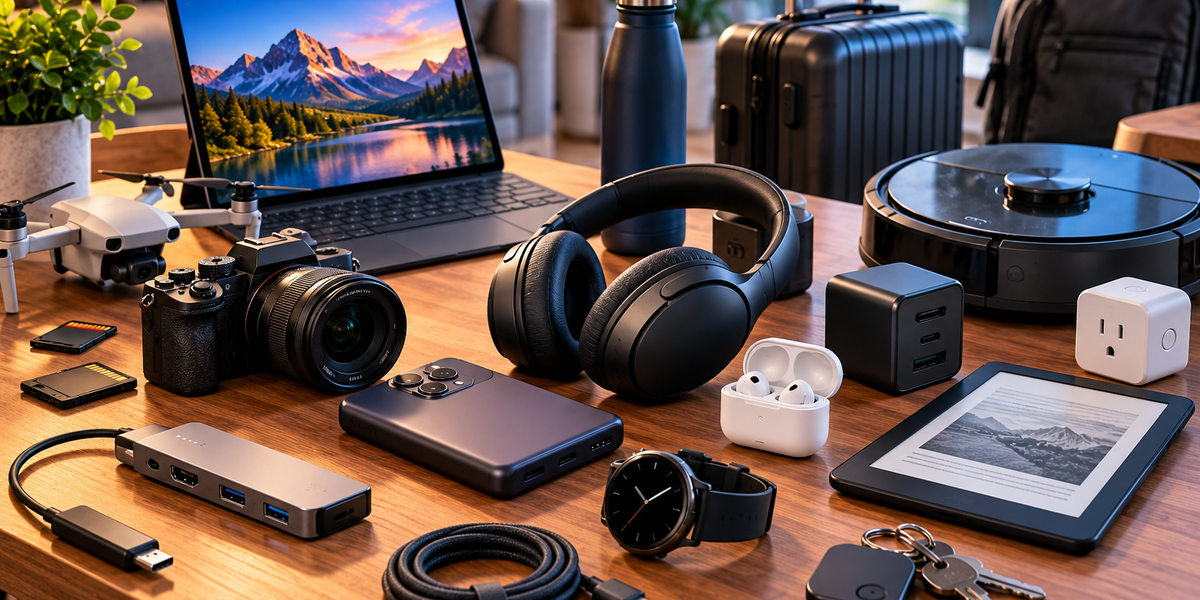
The gadgets worth buying tend to become invisible parts of your routine. You charge your laptop from one compact adapter, put on your headphones before a flight, drop your keys beside a tracker, or let a robot vacuum clean while you do something else.
The gadgets that are a waste keep reminding you that you bought them.
The best technology does not need to make your life feel more technological. It should make some small part of your life easier—and then get out of the way.