How Noise-Cancelling Headphones Actually Cancel Noise
Put on a good pair of noise-cancelling headphones inside an airplane and something remarkable happens. The deep roar of the engines suddenly fades. The ventilation system becomes quieter. The constant low rumble that filled the cabin seems to retreat into the background, sometimes even before you start playing music.
The headphones are not simply blocking the sound with thick padding. They are actively producing sound of their own.
That sounds backwards. If the goal is to make something quieter, why would adding more sound help? The answer comes from the physics of sound waves. Under the right conditions, one sound wave can interfere with another in a way that dramatically reduces what reaches your ears.
This process is called active noise cancellation, or ANC, and it combines microphones, processors, speakers, and some surprisingly elegant physics to create the sensation of quiet.
Sound Is Really a Vibration
To understand noise cancellation, it helps to understand what sound actually is.
When something produces a sound, it creates vibrations. A speaker, for example, rapidly moves backward and forward, pushing and pulling the surrounding air. Those movements create changing patterns of air pressure that travel outward as sound waves.
When the waves reach your ear, they cause your eardrum to vibrate. Your auditory system eventually converts those vibrations into the experience we recognize as sound.
Different sounds create different patterns of pressure changes. A low bass note produces relatively slow oscillations, while higher-frequency sounds involve much faster changes.
Noise-cancelling headphones take advantage of the predictable structure of these waves.
Two Sounds Can Interfere With Each Other
Imagine two waves traveling through the same space.
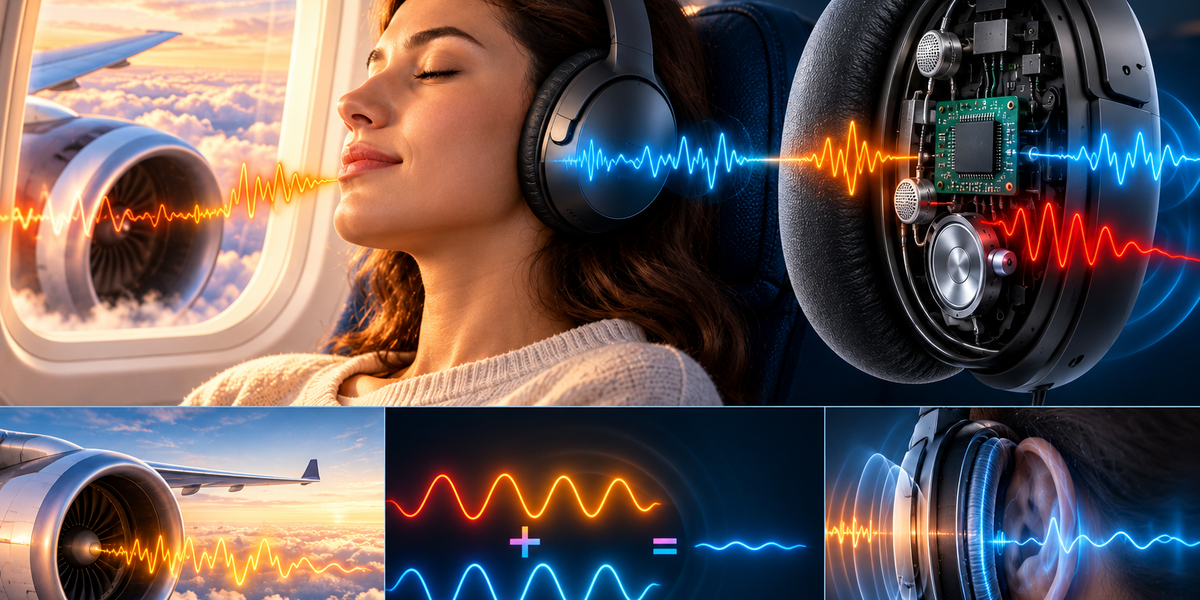
If their peaks and valleys line up, they can reinforce one another, creating a stronger combined wave. This is called constructive interference.
But something different happens when one wave’s peaks line up with the other wave’s valleys.
The pressure changes oppose each other.
If the waves are sufficiently similar in strength but opposite in phase, they can partially or substantially cancel one another. This is known as destructive interference.
Active noise-cancelling headphones attempt to create exactly this situation.
They listen to unwanted noise and generate another sound wave designed to oppose it.
The Headphones First Have to Hear the Noise
Noise-cancelling headphones contain microphones.
Some microphones face outward and listen to the surrounding environment. Others may face inward toward the ear. Many modern systems use combinations of both.
Suppose you are sitting on an airplane. The microphones detect the continuous low-frequency rumble produced by the engines and cabin environment.
That sound is converted into an electrical signal and sent to the headphones’ processing system.
The processor analyzes the incoming noise and calculates a corresponding signal designed to oppose it.
The headphones then play that signal through their speakers.
All of this happens extremely quickly.
The Headphones Create “Anti-Noise”
The term “anti-noise” sounds futuristic, but it describes the idea reasonably well.
Suppose the incoming noise creates a pressure wave that rises, falls, rises, and falls in a particular pattern.
The headphones attempt to generate another wave that does the opposite at the correct moment. When the outside sound pushes air pressure in one direction, the generated wave pushes in the opposing direction.
When those waves meet near your ear, destructive interference reduces the resulting pressure variation.
Your ear therefore receives less of the original noise.
The headphones have not erased the sound from the airplane cabin. The engine is still making exactly the same amount of noise around you.
They have created a tiny acoustic environment near your ears where part of that noise is being counteracted.
Why Timing Has to Be Extremely Precise
Creating the opposite waveform is only useful if it arrives at the correct time.
If the anti-noise signal is delayed too much, it may fail to cancel the original sound. Under some conditions, incorrectly timed sound could even reinforce parts of the noise instead.
The electronics inside ANC headphones therefore have to operate very quickly.
Microphones detect the sound, processors analyze it, algorithms calculate a response, and the speakers reproduce that response with extremely low delay.
Modern digital signal processors can perform these calculations continuously and rapidly enough that the user simply experiences reduced noise.
This is one reason effective noise cancellation requires more than ordinary headphones with a microphone attached.
Why Noise Cancellation Works So Well on Airplanes
Active noise cancellation is particularly effective against low-frequency, relatively consistent sounds.
Aircraft engines are an excellent example. So are train rumbles, bus engines, air-conditioning systems, fans, and the steady background hum of machinery.
These sounds have patterns that are relatively predictable from moment to moment.
That gives the noise-cancelling system enough opportunity to measure them and generate an opposing signal.
This is why putting on ANC headphones during a flight can feel dramatic even when no music is playing.
The headphones are particularly well suited to reducing exactly the kind of constant low-frequency noise that dominates an aircraft cabin.
Why Voices Are Harder to Cancel
Human speech is much more complicated.
A person talking beside you constantly changes frequency, volume, rhythm, and pronunciation. Consonants can contain sudden high-frequency sounds, while words begin and end unpredictably.
The noise-cancelling system has much less time to anticipate and respond to these rapidly changing sounds.
As a result, active noise cancellation generally does not make nearby conversations disappear as completely as it can reduce a steady engine hum.
Voices may become quieter, particularly when passive isolation is also strong, but they often remain audible.
This is not necessarily evidence that the headphones are defective. It reflects a fundamental challenge of cancelling unpredictable sound in real time.
High-Frequency Sounds Are More Difficult
Frequency plays a major role in noise cancellation.
Low-frequency sound waves have relatively long wavelengths and change more slowly. This gives the electronic system more time to respond.
High-frequency waves change much more rapidly. Small errors in timing, microphone position, or the shape of the ear can make precise cancellation considerably more difficult.
Sounds such as clinking dishes, keyboard clicks, certain voices, or sudden sharp noises may therefore pass through more noticeably.
Modern ANC systems have become increasingly sophisticated, but physics still places practical limits on what they can cancel.
Passive Noise Isolation Is Doing Part of the Work
When noise-cancelling headphones make the outside world quieter, active electronics deserve only part of the credit.
The physical design of the headphones also blocks sound.
Over-ear headphones create a seal around the ears using padded ear cups. In-ear earbuds use silicone or foam tips to seal the ear canal.
This is called passive noise isolation.
Passive isolation works without batteries, microphones, or processors. It simply creates a physical barrier that makes it more difficult for outside sound to reach your ears.
It tends to be particularly useful for frequencies that active cancellation struggles with.
The best noise-cancelling headphones therefore combine both approaches: passive isolation reduces sound physically, while active noise cancellation attacks additional noise electronically.
Over-Ear Headphones and Earbuds Solve the Same Problem Differently
Both over-ear headphones and wireless earbuds can provide active noise cancellation, but their physical designs create different challenges.
Over-ear headphones have relatively large ear cups, giving manufacturers more space for microphones, batteries, processing hardware, and acoustic design. The cushions can also create substantial passive isolation around the entire ear.
Earbuds have far less space.
However, because they sit directly inside the ear canal, a well-fitting pair can create an effective seal. Their microphones are also positioned very close to the ear.
Modern processors have become small and energy-efficient enough that surprisingly advanced ANC systems can now fit inside tiny wireless earbuds.
The underlying physics remains the same even though the hardware looks very different.
Feedforward Noise Cancellation Listens Outside
One common ANC design uses microphones positioned on the outside of the headphones.
This is called feedforward noise cancellation.
The external microphone detects incoming sound before it reaches your ear. The processing system then attempts to generate an opposing signal.
The advantage is that the system gets an early measurement of the outside environment.
However, it cannot perfectly know what the sound will be like after it passes through the headphone materials and reaches the inside of your ear.
Changes in fit, wind, and other conditions can therefore affect performance.
Feedback Noise Cancellation Listens Inside
Another approach places a microphone inside the ear cup or near the ear canal.
This microphone can measure what you are actually hearing after outside noise, passive isolation, and the headphone’s own audio have interacted.
The system can then make corrections based on the remaining noise.
This is known as feedback noise cancellation.
Its advantage is that it measures conditions closer to the listener’s ear.
However, the system must carefully distinguish between unwanted noise and the music or other audio that the headphones are intentionally playing.
Sophisticated processing is needed to keep everything under control.
Hybrid ANC Uses Both
Many premium noise-cancelling headphones use hybrid systems combining external and internal microphones.
The outside microphones monitor incoming environmental noise, while the inside microphones monitor what remains near the ear.
The processor can use both sets of information to continuously adjust its response.
This provides a more complete picture of the acoustic environment and can improve cancellation across a wider range of conditions.
It also demonstrates how modern ANC has evolved beyond the simple textbook explanation of “play the opposite sound.”
Real systems constantly measure, calculate, correct, and adapt.
Why the Fit of Your Headphones Matters
Even the most sophisticated noise-cancellation software can struggle if the headphones do not fit properly.
A poor seal allows sound to enter unpredictably.
For earbuds, the correct ear-tip size can make an enormous difference. Tips that are too small may allow outside sound into the ear canal, reducing both bass response and noise isolation.
For over-ear headphones, glasses, hair, ear shape, and cushion condition can influence the seal.
This is why the same headphones can seem excellent to one person and less impressive to another.
The electronics may be identical, but the acoustic environment around each person’s ears is not.
Why ANC Can Create a Strange Pressure Sensation
Some people experience an unusual sensation when they first use strong active noise cancellation. They may describe it as pressure, similar to the feeling of changing altitude.
The headphones are not actually changing the air pressure inside an airplane cabin.
Instead, the removal of strong low-frequency sound can create a sensory experience that some listeners interpret as pressure. The brain is accustomed to certain combinations of sound and physical sensation, and dramatically reducing low-frequency noise can feel unusual.
Many people adapt quickly, while some remain sensitive to the effect.
Some headphones allow users to reduce the strength of ANC, which can make the experience more comfortable.
Why Wind Can Confuse Noise-Cancelling Headphones
Wind presents a special problem because it interacts directly with the microphones.
When air moves across a microphone opening, it can create turbulence and pressure changes that the microphone interprets as sound.
The ANC system may then attempt to respond to those signals.
This can produce rumbling, fluttering, or other strange noises when using noise-cancelling headphones outdoors in strong wind.
Manufacturers use microphone placement, protective materials, software filtering, and wind-detection algorithms to reduce this problem.
However, strong wind remains one of the more difficult environments for active noise cancellation.
Why ANC Needs Battery Power
Ordinary wired headphones can produce sound without having their own battery because the connected device supplies the necessary audio signal and power.
Active noise cancellation requires additional electronics.
Microphones must continuously listen to the environment. Digital processors must analyze sound and calculate cancellation signals. Amplifiers and speakers must reproduce the resulting audio.
All of this consumes electricity.
That is why wireless ANC headphones have a limited battery life and why some models lose active noise cancellation when their battery is depleted.
Passive noise isolation, on the other hand, continues working because it depends only on the physical structure of the headphones.
What Transparency Mode Does
Modern noise-cancelling headphones often include a feature called transparency, ambient, or awareness mode.
Interestingly, it uses much of the same hardware as noise cancellation for almost the opposite purpose.
Instead of using microphones primarily to help suppress outside sound, the headphones deliberately capture environmental audio and play it through the speakers.
This allows you to hear conversations, announcements, traffic, or other surroundings without removing the headphones.
A good transparency mode can feel surprisingly natural because the system processes the microphones’ input so quickly that outside sounds seem to pass directly through the headphones.
In reality, you may be hearing an electronic recreation of the environment.
Adaptive Noise Cancellation Changes Automatically
Some modern headphones go beyond a simple on-or-off ANC switch.
Adaptive systems continuously analyze the environment and adjust the amount or type of noise cancellation.
The headphones may respond differently on a quiet street than inside an airplane. They can sometimes adjust based on movement, wind, fit, or changing noise levels.
Some systems also personalize their response based on the shape of the user’s ears or how the headphones are positioned.
This is possible because ANC is fundamentally software-controlled.
The microphones provide information, and algorithms decide what to do with it.
Better software can therefore improve noise cancellation even when the basic physical principle remains unchanged.
Noise Cancellation Does Not Create Perfect Silence
The phrase “noise cancelling” can create unrealistic expectations.
No consumer headphone can remove every sound around you.
ANC is best understood as noise reduction rather than a magical silence generator.
Steady low-frequency sounds can be reduced dramatically. Passive isolation can suppress additional frequencies. But sudden noises, nearby voices, high-frequency sounds, and vibrations transmitted through physical contact can still reach you.
The result can nevertheless feel extraordinary because our brains are particularly sensitive to constant background noise.
Removing much of that background can make the environment feel dramatically calmer even when some sounds remain.
ANC Can Make Music Easier to Hear at Lower Volumes
One practical advantage of noise cancellation is that you may not need to increase music volume simply to overpower the environment.
Imagine listening to a podcast on an airplane without ANC. The cabin is loud, so you may instinctively raise the volume until the voices become clear over the engine noise.
With effective noise cancellation, much of that background rumble is reduced before it reaches your ears.
The podcast can therefore remain intelligible at a lower playback level.
Noise cancellation does not automatically guarantee safe listening habits, but reducing the need to compete with loud environmental noise can make comfortable listening easier.
The Headphones Are Performing Thousands of Corrections
The most impressive part of ANC is how continuously it operates.
The headphones are not measuring the environment once and generating one permanent anti-noise signal.
Sound around you changes constantly.
The microphones continuously capture those changes. The processor continuously analyzes them. The cancellation signal is continuously recalculated, and the speakers continuously reproduce the result.
If an aircraft engine changes pitch, the system adapts. If you turn your head, the acoustic environment changes and the system responds. If the headphones shift slightly on your ears, internal microphones can help compensate.
This entire feedback process happens so quickly that you do not consciously perceive the calculations.
You simply notice that the world has become quieter.
The Music and Anti-Noise Are Played Together
One detail can initially seem confusing: if the speakers are already producing anti-noise, how can they also play music?
They do both simultaneously.
Digital audio systems can combine multiple signals mathematically before sending the final waveform to the speakers.
The processor takes the music or podcast you actually want to hear and combines it with the calculated cancellation signal.
The speaker produces the resulting waveform.
When that sound reaches your ear together with environmental noise, the cancellation component is designed to oppose part of the outside noise while the desired music remains audible.
The speaker is therefore not switching rapidly between “music mode” and “noise-cancelling mode.” The signals coexist.
The Goal Is Not to Stop the Original Sound
This is perhaps the most important distinction.
Noise-cancelling headphones do not stop the airplane engine from producing sound. They do not create a silent bubble around your entire body, and they do not remove sound waves from the room.
Someone sitting beside you without headphones still hears the normal environment.
The headphones only manipulate the sound reaching a very small area around your ears.
That makes the engineering problem much more manageable. Instead of cancelling an entire room full of sound, the system only needs to create the right acoustic result at two carefully controlled listening positions.
Adding Sound to Create Quiet
Active noise cancellation seems almost contradictory until you understand the physics behind it.
The headphones listen to the world through tiny microphones. Their processors analyze unwanted sound and calculate a response. Their speakers then produce carefully controlled sound waves designed to interfere with part of the incoming noise.
At the same time, physical ear cups or ear tips block additional sound, while software continuously adapts to changes in the environment.
The result is not true silence. It is something more clever: carefully engineered interference that makes your ears experience much less of the noise surrounding you.
That is why putting on noise-cancelling headphones inside an airplane can feel almost magical. The engines have not become quieter. The cabin has not changed.
Your headphones have simply learned how to fight sound with sound.