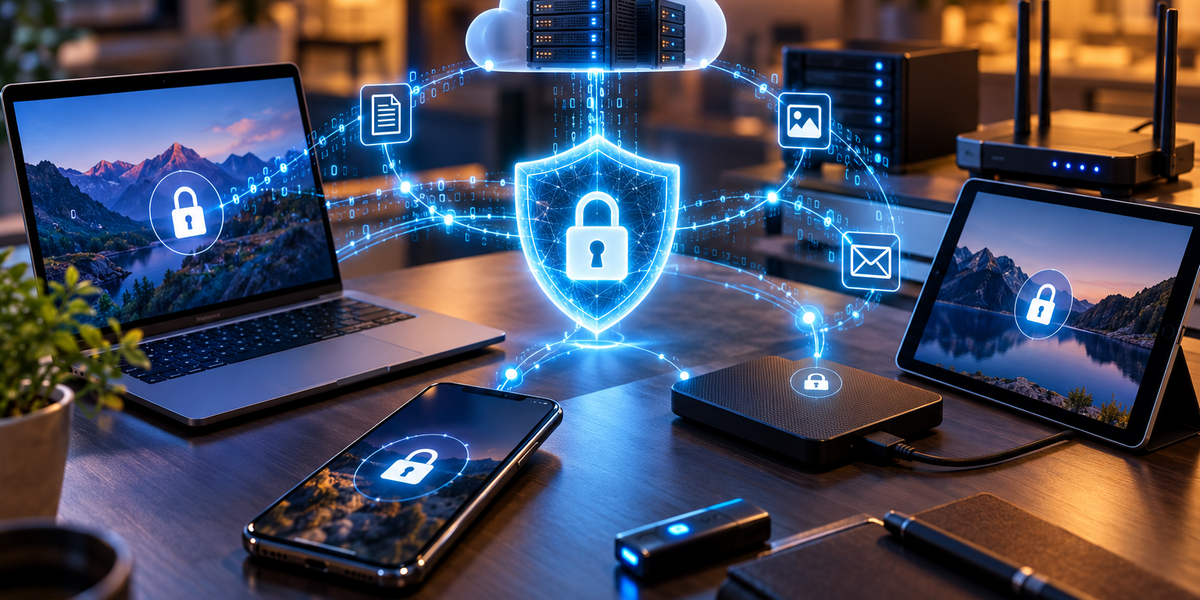
How Encryption Keeps Your Data Safe
Every day, enormous amounts of personal information travel between phones, computers, websites, banks, messaging apps, cloud services, and businesses. You enter passwords, send photographs, make payments, check bank accounts, store documents online, and exchange private messages, often without thinking about how many networks and computer systems that information passes through.
If all of that data traveled in a readable form, using the internet would be extraordinarily risky. Anyone capable of intercepting the information could potentially see what you were sending. One of the main technologies preventing that from happening is encryption.
Encryption takes readable information and transforms it into data that appears meaningless unless you have the correct way to unlock it. It is used throughout modern computing, often without users realizing it. When you visit a secure website, unlock your phone, make an online payment, connect to many Wi-Fi networks, or use an encrypted messaging service, encryption is working somewhere behind the scenes.
The mathematics can become extremely complicated, but the basic idea is surprisingly simple.
What Is Encryption?
Imagine writing a private message and then applying a secret rule that rearranges every letter into something unreadable. Anyone who intercepts the transformed message sees nonsense, while someone who knows the correct rule can reverse the process and recover the original text.
Encryption follows the same general principle, although modern cryptography uses sophisticated mathematical algorithms rather than simple letter substitutions.
The original readable information is often called plaintext. An encryption algorithm transforms that plaintext into encrypted information called ciphertext. A cryptographic key controls the transformation. Someone with the appropriate key can decrypt the ciphertext and recover the original information.
Without the correct key, properly implemented modern encryption is designed to make recovering the original data computationally impractical.
That last part is important. Encryption does not necessarily make something mathematically impossible to break under every imaginable circumstance. Instead, strong modern encryption makes unauthorized decryption so difficult that attempting to defeat it directly can require unrealistic amounts of computing resources and time.
Encryption Is About Keys
The word “key” appears constantly in cryptography because keys are central to how encryption works.
A cryptographic key is not necessarily a password that someone manually types. It is usually a carefully generated sequence of bits used by a mathematical algorithm. Depending on the encryption system, keys can be very large and effectively impossible for a person to memorize.
The strength of an encryption system depends partly on preventing unauthorized people from obtaining these keys. If someone steals the correct encryption key, they may not need to break the encryption at all. They can simply use the key.
This is why key management is one of the most important parts of cybersecurity. Organizations need systems for generating keys securely, storing them, controlling who can use them, rotating them when necessary, and protecting them from theft.
Strong encryption with badly protected keys can still result in insecure data.
Symmetric Encryption Uses One Shared Secret
One major type of encryption is called symmetric encryption. In this system, the same secret key is used to encrypt and decrypt information.
Imagine that you and a friend have identical keys to a locked box. You place a document inside the box, lock it, and send the box to your friend. Your friend uses their copy of the same key to open it.
Symmetric encryption follows a similar concept. A sender uses a secret key to encrypt information, and the recipient uses the same secret to decrypt it.
Modern symmetric encryption can be extremely fast, which makes it useful for protecting large amounts of information. The challenge is securely sharing the secret key in the first place. If you simply send the key through an insecure channel, someone could intercept it and defeat the entire purpose of the encryption.
Solving this key-sharing problem helped lead to another major approach to cryptography.
Public-Key Encryption Uses Two Keys
Public-key cryptography, also called asymmetric cryptography, uses a pair of mathematically related keys rather than one shared secret.
One key is public and can be shared openly. The other is private and must remain secret.
A simplified way to understand the concept is to imagine a special mailbox. Anyone can place a message inside and lock it using a mechanism available to the public, but only the owner possesses the private key capable of opening the mailbox.
This allows people who have never previously exchanged a secret to establish secure communication.
Public-key cryptography is also fundamental to digital signatures, which can help prove that information genuinely came from a particular source and has not been altered.
In practice, modern secure communication often combines asymmetric and symmetric techniques. Public-key cryptography can help establish shared secrets or authenticate participants, while fast symmetric encryption handles the bulk of the actual data.
What Happens When You Visit a Secure Website?
One of the most common places you encounter encryption is the web.
When you visit a website using HTTPS, your browser and the website establish a secure connection using the TLS protocol. You may notice a padlock or similar security indicator in your browser, although modern browsers increasingly treat secure HTTPS connections as the normal default rather than something unusual.
During the connection process, your browser receives information that helps it authenticate the website and establish secure cryptographic keys. Once the secure session is established, information exchanged between your browser and the site can be encrypted.
This prevents someone who merely intercepts the network traffic from easily reading its contents.
If you enter a password into an HTTPS website, for example, someone observing the connection should not simply see your password traveling across the network as readable text.
HTTPS Does Not Mean a Website Is Trustworthy
This is an important distinction.
HTTPS means that the connection between your browser and the website is encrypted and that the website can present a valid certificate for the domain involved. It does not automatically mean that the company operating the website is honest.
A scam website can also use HTTPS.
Think of encryption as a secure delivery service. It can ensure that your message reaches the intended destination without someone casually reading it along the way. It cannot guarantee that the person waiting at the destination has good intentions.
You still need to pay attention to which website you are visiting, particularly before entering passwords, financial information, or personal details.
Encryption in Transit Protects Moving Data
Security professionals often distinguish between data “in transit” and data “at rest.”
Data in transit is information moving between systems. When you send an email, upload a photograph, open a website, or communicate with an online service, information travels through networks between devices.
Encryption in transit protects that information during its journey.
Protocols such as TLS are commonly used to establish encrypted connections between computers. Someone monitoring part of the network may still be able to observe certain information about the communication, such as the fact that traffic exists, but properly encrypted content should not simply appear as readable text.
This is one reason using modern encrypted services is so important on networks you do not fully control.
Encryption at Rest Protects Stored Data
Data at rest refers to information that is stored rather than actively moving across a network.
Your phone contains stored photographs, messages, passwords, documents, and application data. A cloud provider stores information on servers. A company might keep customer records in databases. Encryption can protect this stored information as well.
Modern smartphones commonly encrypt storage so that data is much harder to access without successfully unlocking the device. Computers can use full-disk encryption to provide similar protection.
Cloud providers and businesses also frequently encrypt information stored within their infrastructure.
This can reduce the consequences of certain kinds of theft. If someone steals a storage device containing properly encrypted data but does not possess the necessary keys, physically possessing the hardware does not automatically give them readable access to the information.
What Is End-to-End Encryption?
End-to-end encryption is particularly important for private communication.
In an end-to-end encrypted system, information is encrypted so that the intended endpoints of the conversation hold the necessary keys to read the content. The service carrying the messages is designed not to possess the keys needed to read those messages in their normal form.
Imagine sending a locked box through a delivery company. The delivery company can transport the box and knows where it is going, but it does not have the key needed to open it. Only the intended recipient can unlock the contents.
That is the basic idea behind end-to-end encrypted messaging.
This differs from services where information is encrypted while traveling to the company’s servers but can then be decrypted by the provider. Both systems may use encryption, but they provide different levels and models of privacy.
Encryption Does Not Hide Everything
Even strongly encrypted communication can produce metadata.
Metadata is information about the communication rather than necessarily its content. Depending on the system, this might include when a connection occurred, how much data was transferred, which account participated, or which servers were contacted.
Imagine receiving a sealed envelope through the mail. Someone looking at the envelope may not know what the letter says, but they might still see the sender, recipient, postage information, and delivery date.
Digital communication can work similarly.
Privacy therefore involves more than simply encrypting message contents. Systems must also consider what metadata is generated, stored, and accessible.
How Your Phone Uses Encryption
Smartphones contain enormous amounts of personal information, which makes encryption particularly important.
Modern mobile operating systems can encrypt stored data using cryptographic keys tied to the device’s security architecture and your authentication methods. When you unlock your phone using a passcode, fingerprint, or face recognition, the device uses that authentication as part of a broader process that allows protected information to become accessible.
This does not mean your four- or six-digit PIN is literally the encryption key for every file. Modern devices use much more complicated key-management systems behind the scenes.
Hardware security features can also isolate important cryptographic operations from the main operating system. The goal is to make extracting sensitive keys difficult even if an attacker physically possesses the phone.
That is one reason a strong device passcode matters. Encryption may be sophisticated, but your authentication method is still one of the gates protecting access to it.
Why Passwords Should Not Simply Be Stored as Plain Text
Passwords create a slightly different cryptographic problem.
A responsible online service generally does not need to store your actual password in readable form. Instead, it can use a cryptographic process called hashing.
A hash function takes input data and produces a fixed-size output. Unlike ordinary encryption, hashing is designed to work in one direction. The system can calculate a hash from your password, but it should not be able to simply reverse the hash to recover the original password.
When you later log in, the service processes the password you enter and compares the result with the stored value.
Secure password storage also uses techniques such as unique salts and deliberately slow password-hashing algorithms to make large-scale password guessing more difficult.
This is why well-designed systems can verify that you entered the correct password without needing to keep the password itself in readable form.
Encryption Cannot Protect a Bad Password From Everything
Encryption and passwords solve different problems.
A system might use excellent encryption, but if your account password is “password123” and an attacker successfully guesses it, the encryption may not prevent them from accessing your account through the normal login process.
Similarly, if you reuse the same password across many websites and one service suffers a breach, attackers may try those stolen credentials elsewhere.
This is why account security usually requires several layers working together. Strong encryption protects data, unique passwords protect accounts, and multi-factor authentication can create an additional barrier if a password is compromised.
Security is strongest when these protections reinforce one another.
What Is Multi-Factor Authentication Doing?
Multi-factor authentication, or MFA, is not itself encryption, but it complements encryption by making unauthorized account access more difficult.
A traditional login asks for something you know, usually a password. MFA requires an additional form of verification, such as something you possess or something associated with your device or identity.
This means that stealing your password may not be enough for someone to enter the account.
Some authentication methods are stronger than others. Modern passkeys and hardware security keys, for example, can use public-key cryptography to authenticate users without transmitting a reusable password to the website.
The broader principle is straightforward: important information should not depend on a single defensive barrier.
Can Encryption Be Broken?
Weak encryption absolutely can be broken. Old cryptographic systems have been defeated as computing power and mathematical knowledge have improved.
Modern encryption algorithms are designed with this history in mind. They use large key spaces and carefully studied mathematical structures that make brute-force attacks impractical when implemented correctly.
Rather than attempting to mathematically break strong encryption, attackers often look for easier paths. They might steal a password, trick someone through phishing, exploit a software vulnerability, compromise an endpoint, steal encryption keys, or convince a user to install malicious software.
This is an important lesson about cybersecurity. Attackers usually do not attack the strongest part of a system if a weaker path is available.
Excellent encryption cannot protect data after an attacker has legitimately gained access to an unlocked device or compromised the software reading the decrypted information.
Why Software Updates Matter for Encryption
Encryption algorithms may be mathematically strong while the software implementing them contains mistakes.
Security researchers regularly discover vulnerabilities in operating systems, browsers, applications, networking protocols, and cryptographic libraries. Some weaknesses can allow attackers to bypass protections without directly breaking the underlying mathematics.
Software updates frequently contain security patches that fix these problems.
This is why updating a phone or computer is not merely about receiving new features or interface changes. Security updates repair weaknesses that attackers may otherwise exploit.
Strong cryptography depends on strong implementation.
What Encryption Protects During Online Banking
Online banking provides a useful example of several security layers working together.
When you connect to your bank’s website or app, encryption protects information traveling between your device and the bank’s systems. Authentication mechanisms help establish that you are authorized to access the account. The bank’s internal systems apply additional security controls to stored information and transactions.
However, encryption cannot stop every kind of fraud.
If someone tricks you into entering your banking credentials on a fake website, the connection to that fake website might itself be encrypted. The technology successfully protected your information while it traveled directly to the scammer.
This is why cybersecurity depends on both technical protections and human judgment. Encryption protects communication, but users still need to communicate with the correct destination.
Encryption Is Everywhere Because Digital Trust Depends on It
Modern life would look dramatically different without strong encryption.
Online shopping would be far more dangerous because payment details could be exposed while traveling across networks. Remote work would be difficult because businesses could not safely exchange confidential information. Cloud storage would carry much greater risk. Private messaging would be far less private, and online banking would be extraordinarily difficult to secure.
Encryption provides a foundation for trust between devices that may be thousands of miles apart.
When your browser communicates with a server on another continent, the two computers may never have interacted before. Cryptographic systems allow them to establish protected communication over networks that neither side fully controls.
That ability is one of the technologies that made the modern internet possible.
Encryption Is Powerful, but It Is Not Magic
Encryption is sometimes described as though it creates an impenetrable shield around information. The reality is more nuanced.
Encryption protects data from specific threats. It can make intercepted information unreadable, protect stored files from unauthorized access, authenticate digital systems, and help detect tampering.
But it cannot protect you from every security problem. It cannot stop you from sending information to the wrong person. It cannot prevent every phishing attack. It cannot automatically secure a compromised device, and it cannot compensate for every weak password or software vulnerability.
Security works in layers, and encryption is one of the strongest layers available.
The basic idea remains beautifully simple. Take readable information, transform it using mathematics and a cryptographic key, and make sure only authorized parties have what they need to turn it back into something meaningful.
Behind that simple concept is some of the most sophisticated mathematics and engineering in modern technology. Yet most of us use it dozens or hundreds of times every day without noticing.
Every secure website you visit, every protected connection you establish, and every encrypted message you send depends on the same fundamental goal: making sure that your information can travel through a connected world without automatically becoming everyone else’s information too.